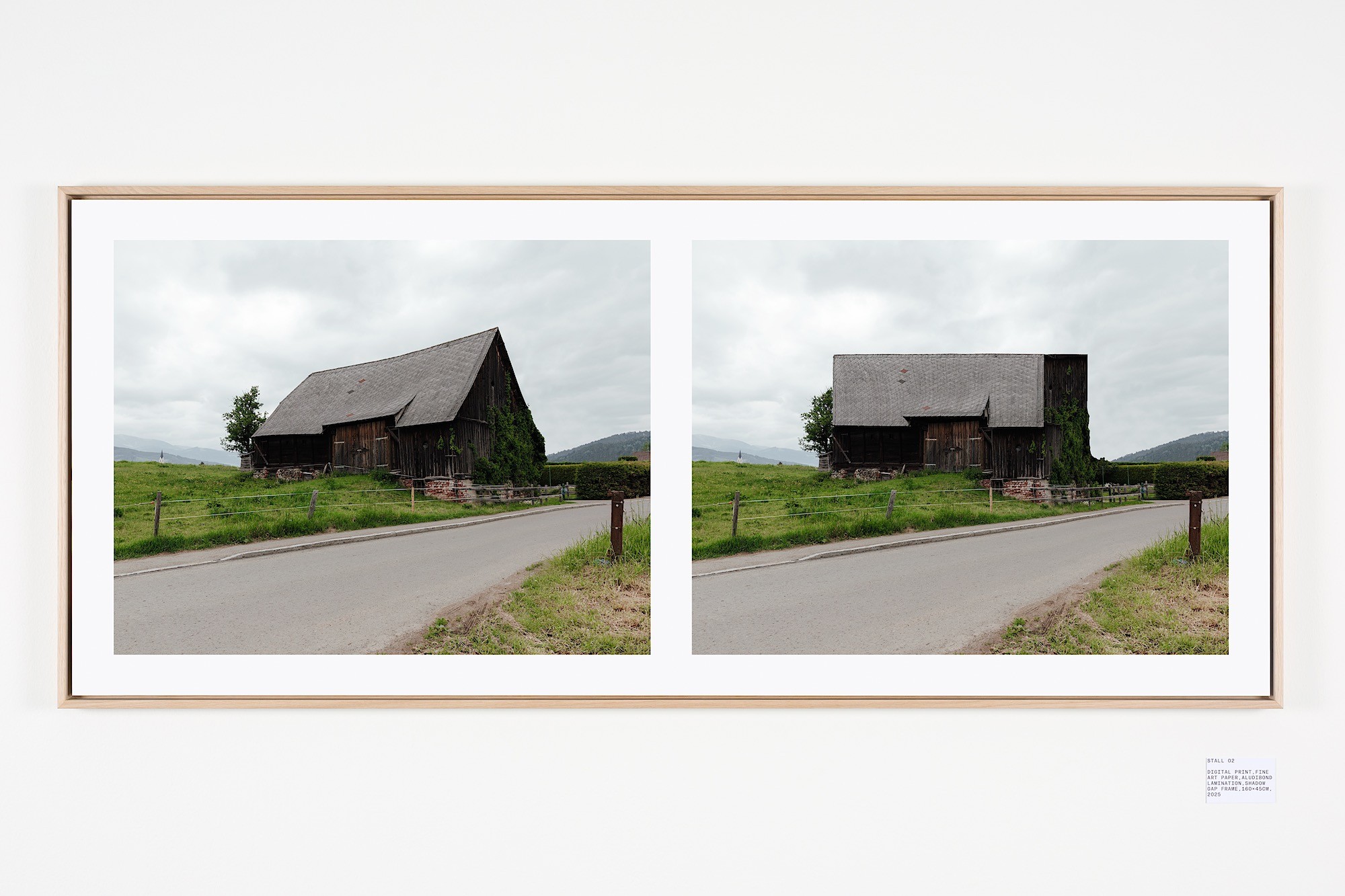
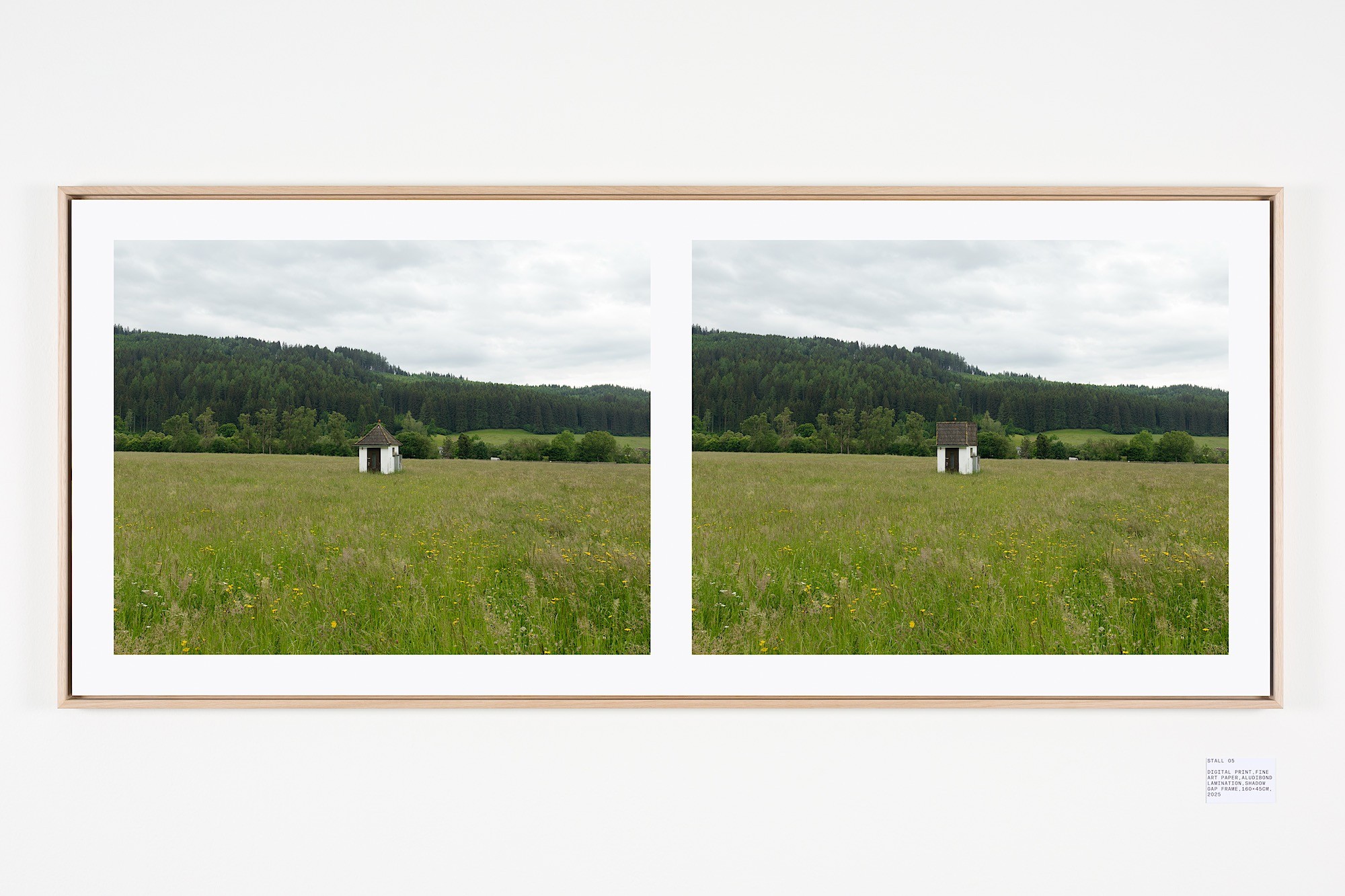
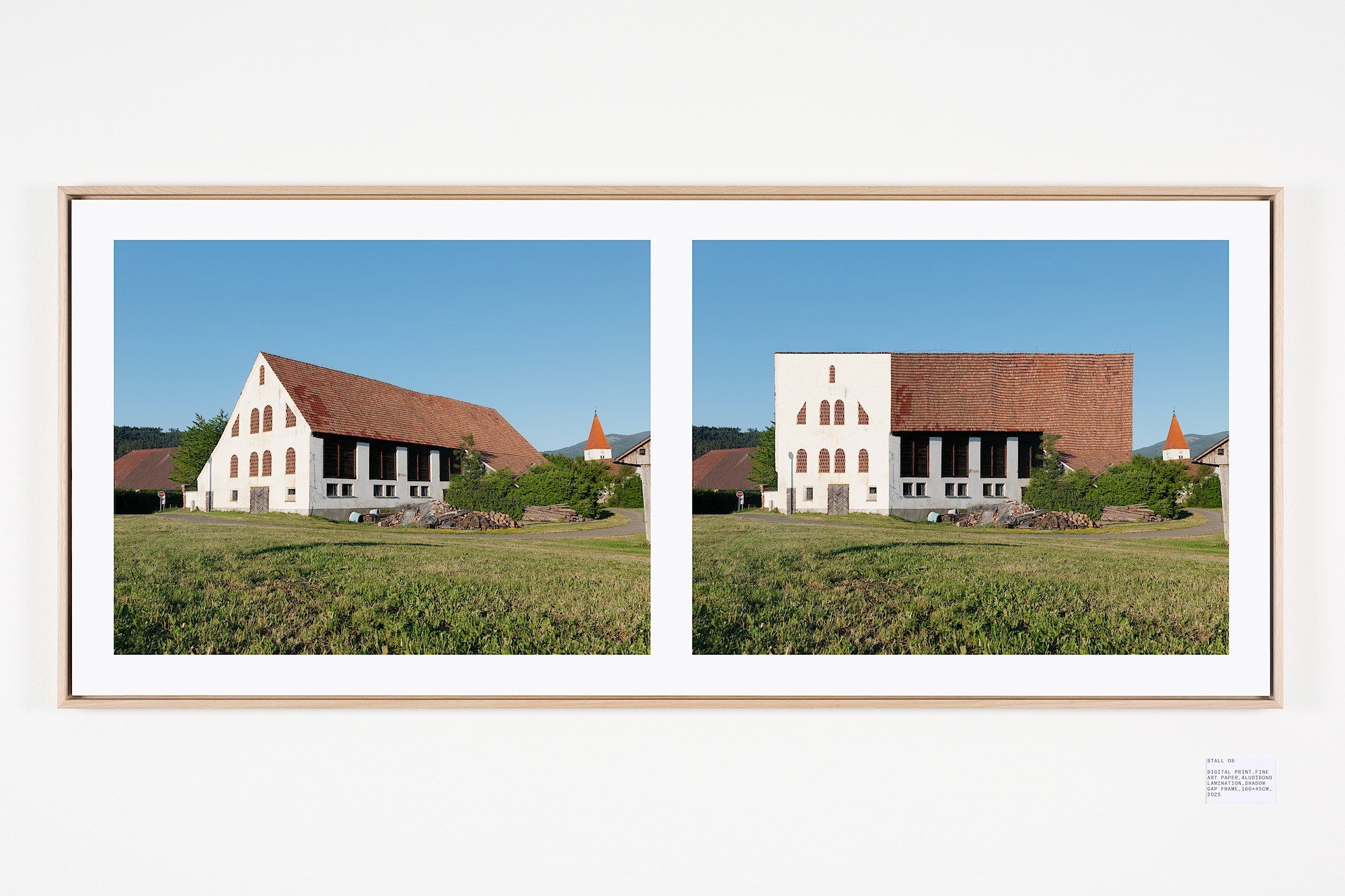
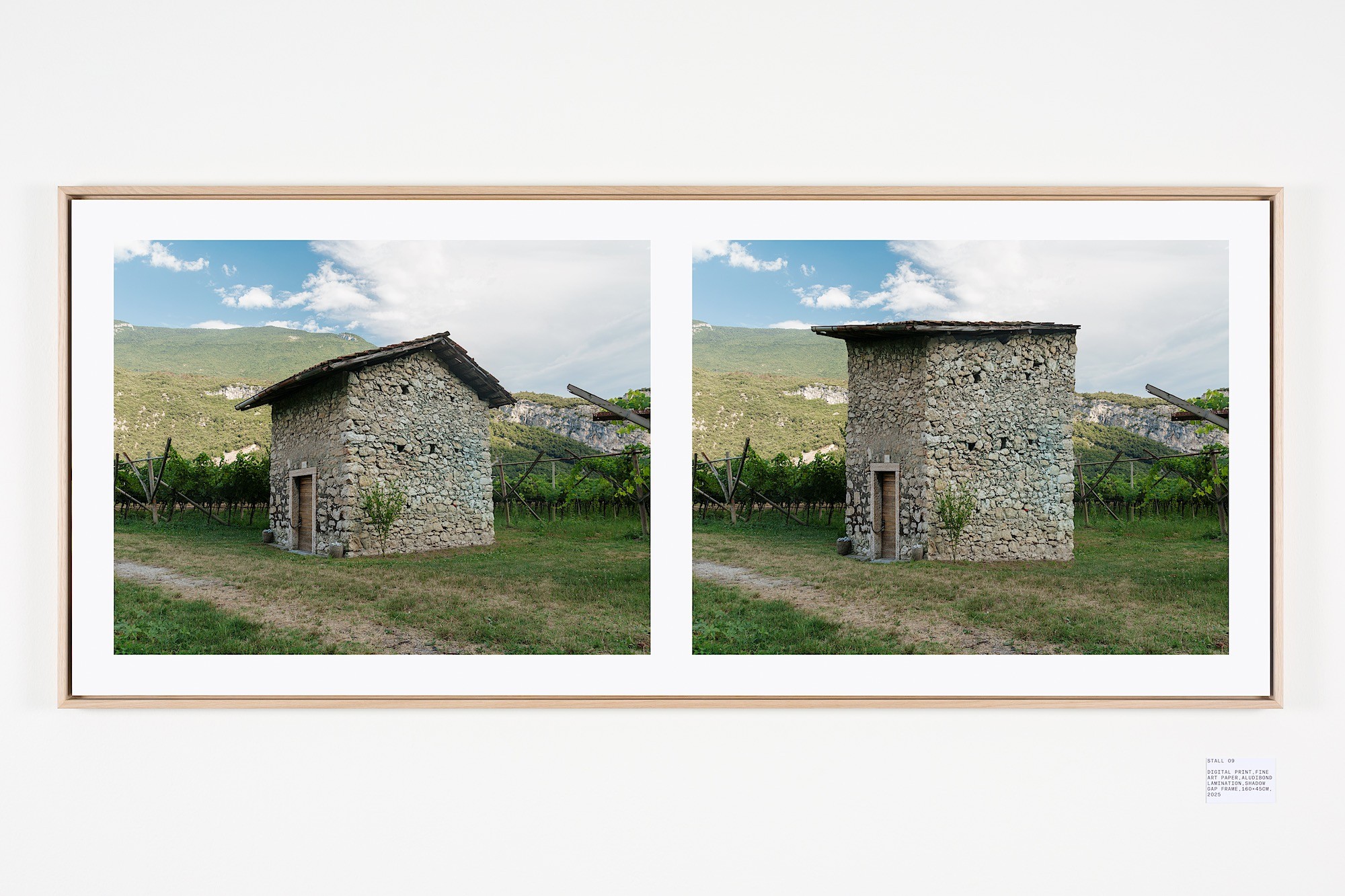
Stall 01, 63 × 148 cm, 2020 | Stall 02, 63 × 148 cm, 2020 | Stall 03, 63 × 148 cm, 2020 | Stall 04, 63 × 148 cm, 2020 | Stall 05, 63 × 148 cm, 2020 | Stall 06, 63 × 148 cm, 2025 | Stall 07, 63 × 148 cm, 2025 | Stall 08, 63 × 148 cm, 2025 | Stall 09, 63 × 148 cm, 2025 | Stall 10, 63 × 148 cm, 2025 | Stall 11, 63 × 148 cm, 2025 | Stall 12, 63 × 148 cm, 2025 | Stall 13, 63 × 148 cm, 2025 | Stall 14, 63 × 148 cm, 2025 | Stall 15, 63 × 148 cm, 2025 | Shadow gap frame, Detail
Works:
Stall
Photo,
|
63 × 148 cm
|
fine art print, alu-dibond, shadow gap frame
|
The series Stall began in 2020 as a factual, photographic archive of traditional barn structures in Upper Styria and has been continuously developed ever since. Its conceptual approach is to capture rural architecture in its clarity and functionality and subsequently transform it through manual image editing in Photoshop. Each photograph is taken using exactly the same composition and framing in order to ensure documentary precision. Over time, the project has expanded to include barn structures from additional regions closely connected to the biographies of the Brenner–Havelka–Plessl collective: Trentino–South Tyrol (Italy), Moravia (Czech Republic), and Upper Styria (Austria). This creates a personal, geographically rooted atlas of rural architecture in Central Europe. The project is realised in collaboration with photographer Daniel Kindler.
The editing of the photographs goes far beyond mere technical correction. It is a deliberate, manual intervention, an old-fashioned act of image-making in which the forms of the barn structures are digitally altered by hand. This process stands in contrast to the widespread use of artificial intelligence in contemporary image editing, which could easily automate such interventions. By insisting on manual editing, the human creative act remains central. The editing process points to the relationship between humans and their environment, comparable to the physical, non-automated labour of agriculture, in which every step is determined by human effort.
The exhibition Very unintelligent work refers to the tradition of the New Objectivity and introduces, for the first time, the term Austrian Objectivity, an approach that seeks to present things in their own “simplicity” and “beauty.” At the same time, the notion of objectivity is critically questioned: through exaggerated reduction and enforced uniformity, it is pushed to the point of absurdity, until, in the end, nothing remains but a square.
The series Stall began in 2020 as a factual, photographic archive of traditional barn structures in Upper Styria and has been continuously developed ever since. Its conceptual approach is to capture rural architecture in its clarity and functionality and subsequently transform it through manual image editing in Photoshop. Each photograph is taken using exactly the same composition and framing in order to ensure documentary precision. Over time, the project has expanded to include barn structures from additional regions closely connected to the biographies of the Brenner–Havelka–Plessl collective: Trentino–South Tyrol (Italy), Moravia (Czech Republic), and Upper Styria (Austria). This creates a personal, geographically rooted atlas of rural architecture in Central Europe. The project is realised in collaboration with photographer Daniel Kindler.
The editing of the photographs goes far beyond mere technical correction. It is a deliberate, manual intervention, an old-fashioned act of image-making in which the forms of the barn structures are digitally altered by hand. This process stands in contrast to the widespread use of artificial intelligence in contemporary image editing, which could easily automate such interventions. By insisting on manual editing, the human creative act remains central. The editing process points to the relationship between humans and their environment, comparable to the physical, non-automated labour of agriculture, in which every step is determined by human effort.
The exhibition Very unintelligent work refers to the tradition of the New Objectivity and introduces, for the first time, the term Austrian Objectivity, an approach that seeks to present things in their own “simplicity” and “beauty.” At the same time, the notion of objectivity is critically questioned: through exaggerated reduction and enforced uniformity, it is pushed to the point of absurdity, until, in the end, nothing remains but a square.








Stall
Works:
Photo,
Photo,
|
63 × 148 cm
63 × 148 cm
|
|
fine art print, alu-dibond, shadow gap frame
fine art print, alu-dibond, shadow gap frame
|
|